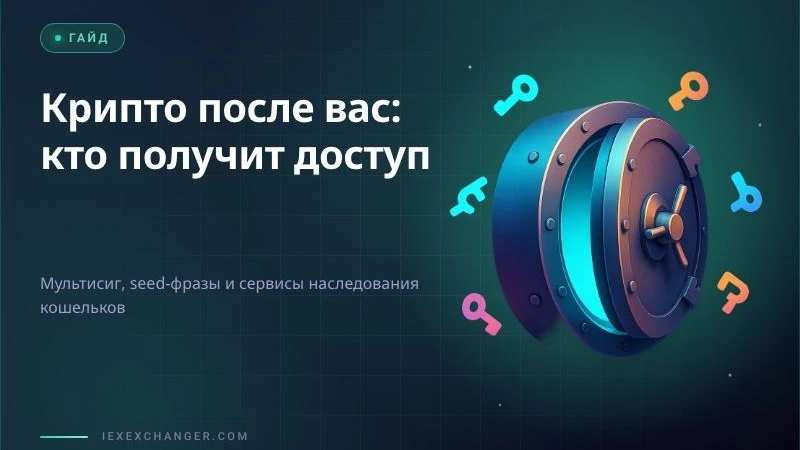
Crypto wallet inheritance is the problem nobody wants to think about: if only one person holds the private key, the coins can become permanently unreachable the moment that person dies or simply forgets. Banks have notaries and probate courts for this. Blockchains have no one who can "just hand over access" to an heir. Here's what actually works — multisig with trusted people, splitting the seed phrase, and dead man's switch services — plus the mistakes that cost families everything.
What Actually Happens When a Wallet Becomes Unreachable
The coins don't disappear technically — the blockchain keeps running exactly as before. But without the private key, the balance becomes permanently out of reach, and that's math, not paperwork; no court order rewrites it.
Blockchain analysts estimate a meaningful share of all bitcoin ever mined sits in wallets nobody can access anymore — not stolen, just lost: a forgotten key, a dead hard drive, an owner who never wrote anything down. It's not a rare horror story. It's a structural risk for anyone who self-custodies.
Why a Regular Will Doesn't Solve It
Writing "leave the Bitcoin to my son" in a will is legally fine and practically useless without the key itself. A notary can certify the document, a court can confirm the inheritance — and the heir still hits a seed-phrase field with nothing to type into it.
It gets worse if you write the seed phrase directly into the will. That document usually sits with a notary or in an archive, sometimes visible to more people than you'd expect, and suddenly becomes a single point of failure — whoever reads it early gets the money early, too.
Multisig: The Inheritance Setup That Actually Works
A multisig wallet that needs several keys to move funds — say, 2-of-3 — splits control without relying on one person or one document. The owner keeps one key, a lawyer or close relative holds the second, and the third sits in a safe-deposit box or with another family member.
Nothing changes day to day: routine spending still needs 2 signatures out of 3, usually the owner's plus one co-holder's. After the owner dies, the remaining two key-holders simply combine their signatures and restore access — no court, no single person who had to know the whole plan in advance. A 3-of-5 setup scales the same idea for larger holdings or more trustees.
Splitting the Seed Phrase, and "Dead Man's Switch" Tools
Shamir's Secret Sharing (SSS) splits one seed phrase into several pieces so that reconstructing it requires a minimum preset number of them — any 3 of 5, for example. A single piece is useless on its own, which is the whole point: it's not the same as just cutting a paper note into four strips.
The other option is dead man's switch services and smart contracts: if the owner stops confirming they're alive — no app login, no signed transaction — for a set period, the system hands access to designated heirs automatically. Convenient, but it adds a third party you now have to trust. Check its track record and code before making it your only plan.
Mistakes That Wreck a Digital Inheritance Plan
- Keeping a single copy of the seed phrase in one place — a fire or a burglary kills access just as thoroughly as forgetting it.
- Telling heirs "what" and "where" but never "how" — a key is useless to someone who's never restored a wallet before and has no instructions.
- Picking a scheme more complex than your trustees can actually run — five people who've never coordinated anything work worse than a simple 3-person setup.
- Never updating the plan after a divorce, a move, or a falling-out with a trustee.
Conclusion
Crypto doesn't forgive a missed step: skip the inheritance plan, and the balance stays on the blockchain while access to it doesn't. For most people, the practical combination is a 2-of-3 or 3-of-5 multisig plus a plain-language recovery guide that's actually been tested once while the owner is still around.
For anyone running an exchanger rather than just a personal wallet, inheritance and backup access stop being a personal choice and become an operational requirement for client funds. Building that kind of controlled-access infrastructure from scratch is easier with iEXWallet.