
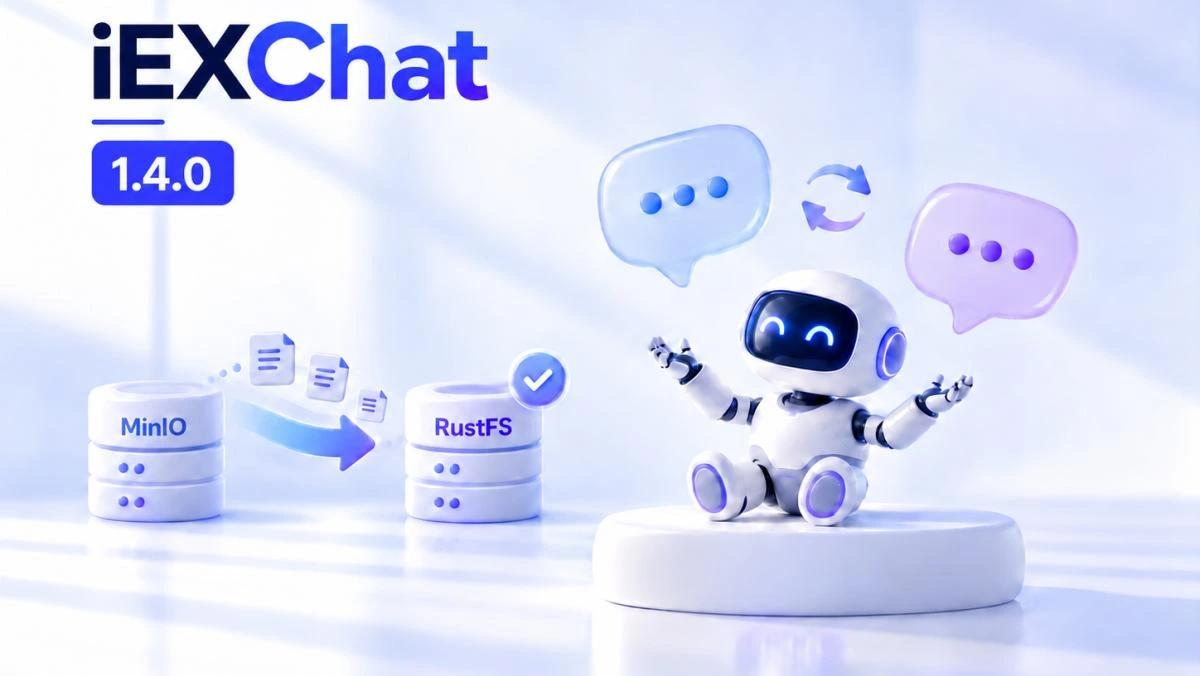
iEXChat 1.4.0 introduces automatic chat translation, widget feature control via the panel, custom pages, chat history download, and new site message settings.
The chat interface, Telegram functionality, and attachment storage have also been updated.
Automatic message translation
Clients and operators can now communicate in their own languages.
Customer messages are translated into the team's language, while operator and bot replies are translated into the visitor's language. The original text remains unchanged and is stored alongside the translation.
Available for connection:
- Anthropic Claude;
- OpenAI-compatible API;
- DeepL;
- Google Cloud Translation.
In the settings, you can select the service, model, command language, and translation directions. Connection checks and usage statistics for the day and month are also available here.
The service key is stored in encrypted form and is not displayed in the panel after saving.
In the chat, the operator sees the translated message and can view the original if needed. The visitor receives the response in their language via the widget, archive, and downloaded history.
Auto-translation also works in personal messages with the Telegram bot. The client's language is detected based on their messages, and before the conversation starts, it is determined by the browser's language.
Files, short replies, and site service messages are not sent for translation. Identical texts are translated once and then reused.
Widget Function Management
A 'Features' section with 23 toggles has appeared in the dashboard.
You can manage the main screen, menu, input field, message feed, files, voice messages, reactions, cryptocurrency addresses, calls, notifications, and other features separately.
If this feature is disabled, the restriction applies not only in the interface. The server also blocks the corresponding action, so it cannot be performed via a direct request.
You can reset the settings to their default values with a single button.
Custom Pages and Updated Interface
You can add up to three custom pages to the widget's bottom menu.
Each page includes a title, icon, and content. Paragraphs, lists, bold text, and links are supported.
Pages can be used for exchange rules, instructions, contacts, FAQs, and other useful information.
The greeting on the main screen can now be edited in the "Content" section. Texts for other languages are managed through the widget translations.
The conversation thread has been updated. The operator's name and avatar appear above the message, with the time and status shown below. Reactions are displayed as separate elements, files appear as cards, and date separators are clearer.
The custom background feature in dark mode has also been fixed. The Escape key now closes the emoji picker window instead of the entire widget.
Download dialogue history
The client can download the chat history in HTML format from the chat menu or after the dialogue ends.
The file contains up to 5,000 messages, including archive, attachments, voice messages, quotes, and reactions.
Internal system events and operator notes are not shared with the client. Downloading history is recorded in the panel.
Methods IEXChat.send and openWith can now immediately open the required dialog. The text provided by the site can be sent automatically or simply inserted into the input field for the client to edit independently.
Website message management
A 'Site Messages' section has been added to the settings.
The administrator can define:
- Whether to receive messages from the site;
- display them as a regular message or a separate card;
- whether to create a new conversation;
- whether to reopen a completed conversation;
- whether to send a notification to operators.
The external API operates under the same rules, and the service source fields are protected from substitution.
A dedicated toggle for automatic site messages has been added in Telegram. Events like “New order created” no longer need to be sent to the team chat.
The system also does not send the operator an unnecessary "New Dialogue" notification if the request was created by the website or a silent system message.
Attachment Storage
The new iEXChat setup uses RustFS for file storage.
Buckets and access rules are created automatically. File exchanges occur directly between containers and do not go through the public domain or Cloudflare.
Existing installations continue to operate on MinIO. The transition to RustFS is carried out separately and only by administrator decision.
Before switching, the system copies and verifies the files. Stopping the services takes about one minute. Rollback can be performed if necessary.
Changes in the dashboard
The "Banner for All" tool has been updated.
You can now choose a display duration from 30 minutes to 24 hours, preview the banner, and quickly disable an active message.
If cryptocurrency address recognition is disabled for the site, such addresses will no longer be highlighted in the panel.
Fixes and Testing
Unsigned data is now ignored and does not disrupt the chat. Blocking is applied only when an explicit block code is received.
Enhanced verification of disabled features is also in place. File sending cannot be bypassed by pasting from the clipboard, dragging, or changing the file type. Voice messages are accepted only as audio files.
Additionally, fixed issues with disabled screens, the ‘Help’ section, custom pages, and the initialization of the file storage.